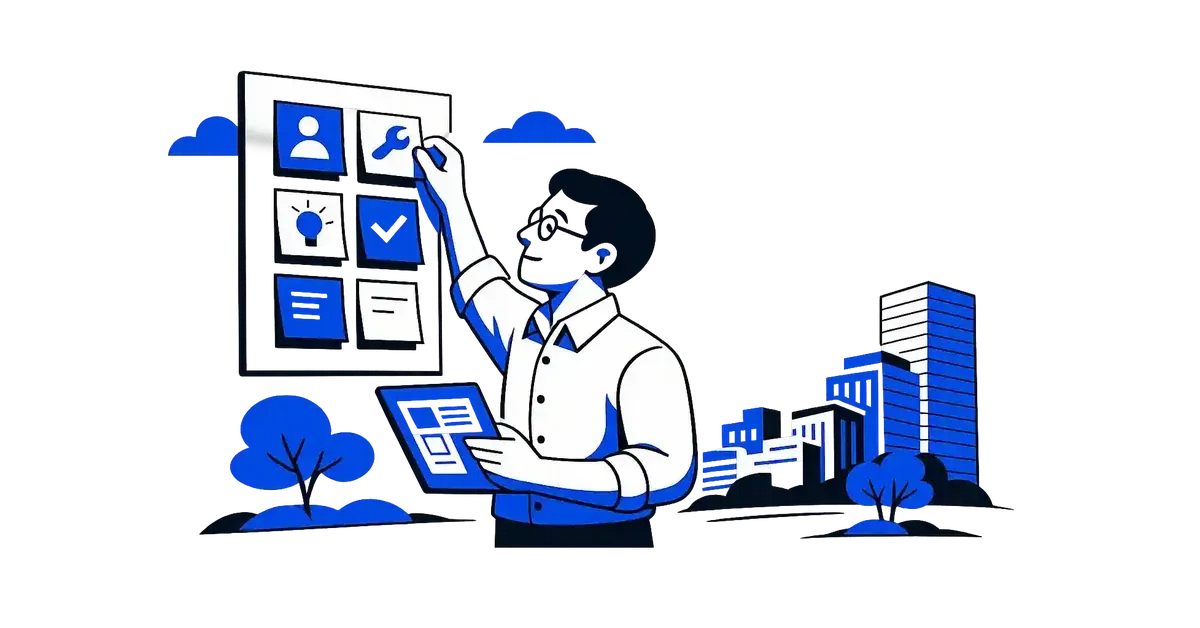
A product backlog is the operational expression of your product strategy. If the backlog is a dumping ground for every request that has ever been made, the strategy is not doing its job as a filter.
At EverQuote, when I joined as SVP Product, the backlog had several hundred items with no meaningful type distinction. Engineers were being asked to weigh a new consumer-facing feature against a database refactor against a UX research task. Prioritization meetings turned into arguments. The loudest voice usually won. Within a quarter, we restructured the backlog by type, assigned capacity budgets to each category, and prioritized within categories - not across them. That change alone freed up enough engineering focus to drive what became a significant part of the $200M in incremental revenue we generated over the next two years.
Here are the eight backlog item types I use, what each one is actually for, and how to think about allocating capacity across them - which is the question most guides skip entirely.
The most useful backlog structures are organized around outcomes, not features. Each item should trace to a key metric or product goal — if it does not, it either belongs in an icebox or it reveals a gap in the strategy.
1. User Story
A user story is the atomic unit of customer-facing work. It answers three questions: who benefits, what they need, and why it matters. The standard format: 'As a [user type], I want [goal] so that [reason]' isn't just a template. It forces the team to articulate the value before committing the work.
Backlog refinement is a roadmap planning activity, not a sprint ritual. The team should be asking 'does this still belong at the top of our priorities given what we have learned' at every planning cycle.
The 'so that' clause is where most teams get sloppy. Without it, you can't prioritize, you can't define done, and you can't tell whether you built the right thing.
User stories work best when they're small enough to complete within a single sprint and large enough to deliver something independently testable. If a story requires five other stories to be complete before it provides any value, it's probably an epic wearing a story's clothes.
2. Epic
An epic is a strategic container for a body of work that's too large to plan in detail at the start. It says: we're going to do something significant in this area, and we'll figure out the details as we get closer.
The mistake most teams make with epics is treating them as a planning artifact rather than a communication artifact. An epic's primary job is to let stakeholders track progress on a major initiative without drowning in story-level detail. At TripAdvisor, when we built out the instant booking product - which eventually scaled to $200M - the epic gave the leadership team a single thread to follow across many months of work. The stories changed constantly. The epic stayed coherent.
An epic's primary job is stakeholder communication, not task management. If your engineers live in the epic, it's too big. If your executives can't find it, it's too granular.
Epics should have measurable success criteria defined before work starts. "Build mobile payment system" is a project. "Reduce checkout abandonment from mobile by 20% through native payment integration" is an epic with a testable outcome.
3. Feature Request
A feature request is external signal - a customer, user, or stakeholder telling you what they want. The raw request is rarely the right solution, but it's almost always pointing at a real problem. Your job is to get underneath the ask and find the need.
I've seen product teams build exactly what customers asked for and then watch them not use it. The customer said they wanted a faster horse. The right move was to ask why they needed to go faster, then decide whether a horse or a car was the right answer.
Feature requests belong in a separate queue from internal stories. They need a different intake process: triage, frequency analysis, and translation into problem statements before they earn a spot in sprint planning. The raw volume of similar requests is a signal, not a mandate. Ten customers asking for the same thing means the problem is real. It doesn't tell you the right solution.
4. Bug Fix
Bugs erode trust faster than missing features. A user who encounters a login timeout or a broken checkout flow doesn't think 'this company has technical debt' - they think 'this product doesn't work.' The reputational damage is immediate and the recovery is slow.
The mistake teams make is treating all bugs as equal-priority interrupts. A bug causing 100% failure on the checkout flow is not in the same category as a display issue in a rarely-visited settings page. The triage system matters more than the bug count.
A product with 200 known bugs and a clear severity system is in better shape than one with 20 bugs and no triage discipline. The number isn't the problem - the absence of a system is.
I use four severity levels: blocker (stops core user journey), critical (major functionality broken for significant user segment), major (notable degradation, workaround exists), minor (cosmetic or edge case). Only blockers and criticals interrupt sprint commitments. Everything else goes in the bug queue and competes for capacity in the next cycle.
5. Technical Debt Item
Technical debt is the tax you pay on past decisions. Every shortcut taken under deadline pressure, every component that was 'good enough for now,' every system that was built for a scale you haven't reached yet - these accumulate interest over time in the form of slower development, more bugs, and harder-to-onboard engineers.
The challenge is that technical debt is invisible to everyone except the people closest to the code. Business stakeholders don't see it. Customers don't feel it until it causes an outage or a performance problem. This makes it easy to deprioritize and easy to justify deprioritizing - right up until it becomes a crisis.
Technical debt is invisible to everyone except the engineers writing the code. Your job as a product leader is to translate it into business risk before it becomes a business problem.
The way to make technical debt visible is to tie it to business outcomes. 'Refactor the authentication module' is invisible. 'Reduce average login time from 4 seconds to under 1 second, which our data shows correlates with a 12% improvement in day-7 retention' is a business case. Same work. Completely different conversation in a prioritization meeting.
6. Spike
A spike is time-boxed research. It produces knowledge, not code. It belongs in the backlog when you can't reliably estimate a piece of work because you don't understand it well enough yet.
The pattern I see in teams that skip spikes is predictable: engineers estimate a task based on partial information, the actual complexity turns out to be much higher, the sprint fails to deliver, and the team loses credibility with stakeholders. A one-day spike that reveals a 3-week implementation hidden inside what looked like a 2-day feature pays for itself many times over.
7. Research and Discovery Item
Research and discovery items are different from spikes. A spike reduces technical uncertainty. A research item reduces market or user uncertainty. It answers questions like: do users actually want this, are they willing to pay for it, and are we solving the right problem?
The teams that skip this type of item are the ones that build features no one uses. At EverQuote, before committing engineering resources to a major consumer product initiative, we ran structured discovery - user interviews, prototype testing, competitive analysis - as formal backlog items with defined deliverables. The output wasn't a deck. It was a go/no-go recommendation with evidence. That distinction matters. Research that doesn't produce a decision isn't research - it's delay.
Research that doesn't produce a decision isn't research - it's delay. Every discovery item needs a defined output: a recommendation, a prototype, a go/no-go. Not a summary.
8. Improvement Initiative
An improvement initiative is the systematic version of polish. It's not fixing a bug - it's improving something that already works in order to make it work significantly better. The distinction matters because improvement initiatives require data to justify and metrics to validate.
The best improvement initiatives come from looking hard at your funnel and asking where the friction is. Not 'what can we make better' in the abstract, but 'where are users dropping off, taking longer than expected, or needing support?' A checkout flow with a 15% abandonment rate isn't broken - it just has room to improve. That's a different kind of work than a bug fix, and it deserves its own planning track.
How I Actually Prioritize These in Practice
The prioritization question every team eventually hits: when user stories, bug fixes, and technical debt are all competing for the same two-week sprint, how do you decide?
The answer is that you don't compare them directly. You set capacity budgets first, then prioritize within each category. Comparing a user story to a technical debt item is a category error - they're optimizing for different things on different time horizons.
Don't rank a user story against a technical debt item. Set capacity budgets per category first, then prioritize within each. Comparing across categories is a category error.
The capacity budget I use as a starting point
This isn't a universal rule. Adjust based on your product's current health and stage:
- 60% new feature work - user stories, epics, improvement initiatives with clear user-facing value
- 20% technical debt - proactive investment in system health, not reactive firefighting
- 10% bug fixes - non-blocker bugs; blockers and criticals get pulled from wherever necessary
- 10% research and spikes - discovery work that de-risks the next planning cycle
A post-launch product carrying two years of accumulated technical debt needs a different ratio - maybe 40/35/15/10 until the debt is under control. A pre-launch product should be closer to 70/10/10/10. The ratio is a dial, not a rule.
Within each category, prioritize by business impact
User stories and feature requests should map to a metric you're actively trying to move. If you can't draw a line from a backlog item to a KPI - activation rate, retention, conversion, revenue - that's a signal it doesn't belong in the current cycle. Save it for later or kill it.
Technical debt items should be tied to velocity impact or risk. 'This refactor will reduce average build time by 40%' is prioritizable. 'This is cleaner code' is not.
The teams that manage this well treat the backlog as a strategic conversation, not a running list. The eight categories above create the conditions for that conversation to happen because they give everyone a shared language for what kind of work is being proposed and why.
Product Backlog Item Comparison
| Item | Implementation Complexity 🔄 | Resource Requirements ⚡ | Expected Outcomes 📊 | Ideal Use Cases 💡 | Key Advantages ⭐ |
|---|---|---|---|---|---|
| User Story | Low - simple format, focused on user value | Low - minimal technical detail | Clear understanding of user needs and priorities | Capturing user requirements, sprint planning | Easy to understand; promotes user-centric thinking |
| Epic | High - large, multi-sprint scope | High - involves multiple teams/stories | Strategic alignment, big-picture feature planning | Organizing major features or initiatives | Facilitates long-term planning and stakeholder communication |
| Feature Request | Medium - varies depending on detail | Medium - includes evaluation and prioritization | Product improvements and enhanced functionality | Collecting new functionality suggestions | Captures market/user feedback; data-driven prioritization |
| Bug Fix | Medium - requires root cause analysis | Variable - depends on defect complexity | Improved product quality and reliability | Correcting defects and errors | Enhances user satisfaction; reduces support costs |
| Technical Debt Item | Medium to High - technical expertise needed | Medium to High - skilled resources required | Better maintainability, performance, and scalability | Refactoring, performance, and architectural improvements | Improves long-term velocity; reduces future costs |
| Spike | Low to Medium - time-boxed research activity | Low - time boxed, focused resource use | Knowledge acquisition; reduced project risk | Exploring unknowns, technical feasibility studies | Reduces uncertainty; informs decisions early |
| Research and Discovery Item | Medium - involves qualitative/quantitative methods | Medium to High - specialized skills/resources | Informed product strategy and validated assumptions | User research, market analysis, competitive research | Reduces risk of unwanted features; data-driven insights |
| Improvement Initiative | Medium - focused on enhancements | Medium - resources for analysis and testing | Optimized existing features and processes | Enhancing UX, process improvements based on feedback | Improves satisfaction and ROI; responsive to user needs |
Working Through Backlog Prioritization Challenges?
Backlog prioritization is one of the most consistent friction points I see in product organizations - teams that are busy but not moving the right things forward. If you're a product leader or founder who wants an outside perspective on how your team is operating, let's talk.